30 April 2013

Z is for Zero Hour


To me, a zero hour is essentially a time limit. And a zero hour item is an item that will destroy itself in a certain amount of time. Whether that be a time bomb, or some item that requires constant charging or feeding. Time limits in tabletop games are a tricky thing, but I know from personal experience they can be extremely rewarding. The difficulty arises from the passing of time. How does one fairly adjudicate how fast time passes in a game where a lot of the details are glossed over for ease of play? If players trust the DM to be on their side, everyone can work together to make a time limit fun and tense. In my games, I tend to use zero hour items. Some sort of item that will self-destruct if not cared for properly. I've already spoken of the wondrous item that breaks if not charged once a day. But today I'd like to talk about the best zero hour item I've ever given a player, and the resulting mad dash that drove a party to their absolute limits.

In their quest to kill an evil god, the players re-constituted a broken artifact called the Godsbane. Being the only weapon that can kill a god, they desperately needed it for their quest, lest the evil god return to wreak havoc on the realm. However, this weapon had a caveat; it was designed to kill a god, and since it had not yet tasted a god's flesh, it instead hungered each day for something similar. Gods are outsider type creatures, so it yearned for the soul of an outsider of 16 hit dice or more once a day. If it did not deal either the killing blow or its instant death effect to a powerful outsider in a calendar day, it would break forever; never to be constructed again. Obviously, the players, having played for two years previously to get to the point where they could even start to think about taking on a god, did not want to fail this quest.


Their journey took them deep within the earth, where they faced numerous undead. The day was long and tiresome, and no outsiders appeared. The players fought every inch through the darkness, hoping, praying their DM would show mercy. None was forthcoming. At first it was of no concern, but the further they traveled, the more undead they slaughtered, the more tired they became. Then the unthinkable happened. Two members of the six party team died to a banshee. The clerics had not brought resurrections with them that day, not having considered that the day would drag on as it did. The dwarf hoisted the dead up and continued their journey.

After a time, they came across salvation! An outsider! But halt, it was a bound angel, held against his will. The paladin knew no other thought, and freed the angel without hesitation, much to the wielder of the Godsbane's chagrin. Time was wasted arguing over the wisdom of this decision, before they knew they had to continue or risk losing all hope. On they went, avoiding combat any way they could. I had never seen such lateral thinking and careful planning to avoid combat, especially at such high levels where a character can cleave the sun. It was impressive.


Further on, dismay set in, the next level of the deep presented itself, with no outsider in sight. Their guide, an evil blackguard who was the twin of the paladin, held against his will, was allowed a sword and freed of his bondage to aid in the survival of the party. No rest was in store. They asked how much time they had left before the Godsbane shattered: four hours. Their stomachs turned and they continued. It was here the blackguard hatched his escape plan: in this deepest cavern, lie the dreaded fiendwurm. Unbeknownst to those new to these hell beasts, they feed an eternal pit that opens within their stomach into a layer of the Abyss. Through there would the blackguard find his escape.

When they encountered the endless maw, he charged it, fooling the others into thinking he was either brave or foolish. Bit as he approached the creature, they remembered an old tome they once read that spoke of these things and their portal to another realm. They cursed their luck, they needed their guide for these caves were massive and without a map they would wander forever, and certainly not find an outsider in time. And yet, pursuing their captive, where would they end up? They might feed the weapon's thirst but how would they get back? Would the evil god return on his own if they delayed too long? In the end, they could not afford to lose their zero hour weapon, and ran into the wurm's belly, screaming and cursing their foul lot in life.
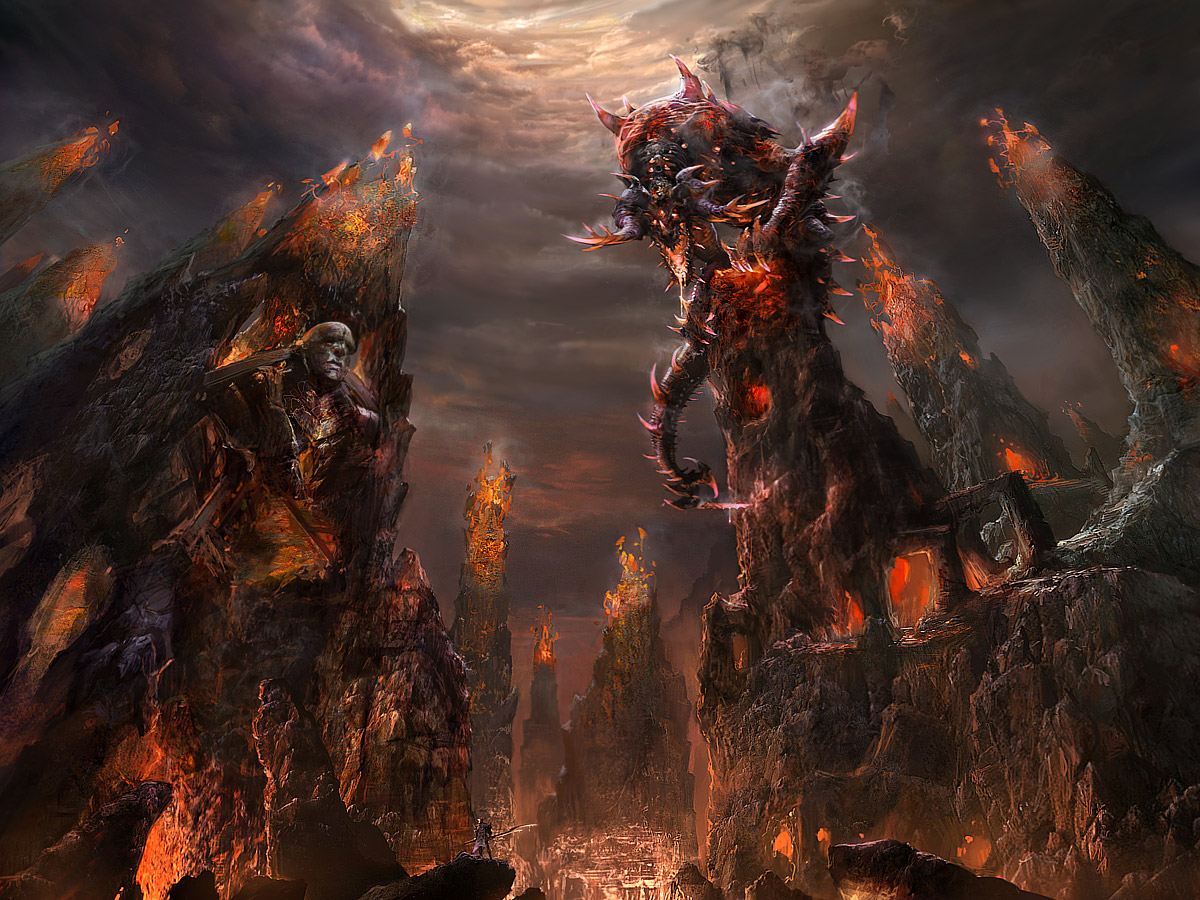

They emerged through and instantly saw their first outsider, a massive demon-dragon that informed them that surrender is their best option. He waved toward a large sack for them all to climb into and accept their death. Of course, the paladin told him in no uncertain terms where he could put said sack. He was pulverized and instantly turned into a soggy meat in armor. Tired and worn out, with almost no spells, and low hit points, the others obeyed. They were taken to a demon prison where they waited out the remaining few hours. They looked at the clock and knew it was an hour until all hope was lost. That is, until an imp named Puck, the bane of their existence and the enemy of the party saw them. Puck was a devil, in the Abyss to convey recon for an invasion of devils. He told them he would break them out and that his boss, Dispater, Lord of the Second Layer of Baator wanted a word with them. From six now to three, the remaining party agreed.

Teleported immediately to Dispater, the players recalled that they had had dealings with this devil before, and that when last they met he had allowed them to leave in exchange for a future boon, which he asked of them now. They agreed, but informed him they needed to feed the Godsbane first. Dispater, being not unreasonable, agreed only if they would best a concordant killer (a type of devil/angel) in an arena. So with an army of devils around them, they entered a small caged arena. They were tired, broken, weak, low on spells, and had the exhausted condition. The three remaining survivors saw that there was only ten minutes left on the clock, and prepared for the most important battle of their lives. The angel's opening move was to forcecage the wielder of the Godsbane, trapping him completely. The players despaired. Rule books were pulled out, spells were researched. There's got to be something they have to get out of forcecage! Time passed while I allowed them to grasp at the straws they had left. Until finally, the wizard came into a realization: dimension door! He used it to get into and then out of the forcecage, freeing the player, who promptly threw the Godsbane at the angel. The weapon flew true, striking the angel in the gut. It rolled its saving throw... and failed! The essence of the outsider was drawn into the weapon as he screamed in agony and fear. The Godsbane pulsated with a greenish glow, and the greater good was served so that a god could be killed.

My players blew a sigh of relief! Glory! A single day of endless fear and desperation. A zero hour run that ended in the most harrowing experience of their adventure yet. To this day, my players still talk of this day, played out over at least two months worth of gameplay sessions. In my opinion, the players had never been so strained or taken to their limits, nor had their characters. They proved to me and themselves what they could accomplish in a single day. They showed me that ingenuity will arise when the characters are stripped of almost all they have, and the game did not suffer, but was instead improved. Sure, today they speak of the day in fear, as they never want to do it again, but they still speak of it. They still remember it. They still revere it as the most tension they have ever had playing this game we call Dungeons & Dragons! Thanks for reading my final A to Z Challenge entry. I hope you enjoyed it. I, for one, am going to take a well-deserved break from writing in this for a few days. But I will return, and continue to write all my opinions and suggestions and hints about how to be the best Dungeon Master one can be. I hope you'll join me and continue to read. What a month!

Relevant Links
Godsbane Wikipedia
Dispater Wikipedia

29 April 2013

Y is for Yesteryear


It is no secret that I am a fan of older versions of D&D. I'm fact, if I could convince my players, we'd all be playing second edition, maybe even first. Generally this preference stems from a distaste for rules, as the more modern the system, the more encyclopedic one's knowledge of the rules must be to play. But a large portion of this preference is due to nostalgia, and a desire to harken back to the good old days of yesteryear.

The first edition I learned to play was second. My older brother introduced me to the game and I remember taking hours crafting my first character. He was a dwarven fighter with an 18/86 Strength named Mad Gort. You may have read little excerpts of his adventures in previous entries. Ever since then I've had a soft spot for fighters, and dwarves. The game had a strange draw to it I couldn't explain. I felt immensely powerful, something that second edition I believe did very well; though still maintaining power in the DM's hands. It had its problems of course, who could forget the confusing system of THAC0, negative AC, and having to remember when rolling high was good and when rolling low was good? Monsters didn't have CR so it was up to the DM to craft his own encounters and hope it was enough to challenge the players but not overwhelm them.

I remember being totally enraptured in the game, to the point where I played until 3am any night we played. The adventures of the past will always be sacred to me. I think that companies have been capitalizing on nostalgia of late, specifically Wizards of the Coast re-releasing the 1st edition rulebook set. I hear the 2nd edition is in the works as well. I will no doubt buy them both.


In the older editions, I felt as if the world was more oppressive. More threatening and dangerous. Random encounter tables were more common then, and occasionally a die rolled an un-winnable encounter. What did the players do? It revolved more around the ability to think on their feet, do things the rules may not allow for, and most importantly encourage creativity in the players. I ran a game where partway through the story, the game switched from 2nd edition to 3rd edition, because most of my players joined in the era when 3rd edition was the primary version. They felt more comfortable using those rules. Almost immediately I saw a decline in the creativity of the solutions for problems, I saw a drop in the way in which they dictated their actions in combat. In went from "I run at the githyanki and make a downward chop to break his face open" to "I make a charge, moving double my speed to the githyanki and make an attack". The descriptive words were lost. All their solutions to problems somehow incorporate their abilities and powers now, not their minds. Lately I will admit I've purposely presented problems that can't be solved by powers and seen a return to the old form, so one could easily make the argument that the problem was me, but I find I am not the only person to have noticed this change in thinking between editions.

I dont want to sound like I don't like 3rd edition and Pathfinder and the OGL rules in general. They're great. I run two OGL games currently. I'll pick up 5th edition when it comes out and probably convert all my games to it. I'm in the beta currently and running a third game of that, just to try out rules and the like, with a party comprised of my wife, my sister, her boyfriend, my brother, and even my mom. It looks good, and if it holds to the old-school vibe I've been getting so far from it, I'll adopt it. But I'll talk more on that another time. Finally if you love old-school gaming, I encourage you to read a file I previously mentioned called "A Quick Primer For Old School Gaming". Tell me about your favorite editions, what edition you were introduced into the game with, and why you love it so much, then tell me about your favorite memories of yesteryear. Thanks for reading, stay tuned tomorrow for the last day of the A to Z challenge in "Z is for Zero Hour".

Relevant Links
A Quick Primer For Old School Gaming

27 April 2013

X is for Xenophobia


I gotta tell you, I struggled over X for a long time. I was on xill for a while, then to xorn. I had to skim through a dictionary before I settled on xenophobia. In the D&D games I've witnessed, xenophobia is not often addressed, but its something I like to put into my games when I can. Essentially, it is the fear of the strange or different. This can be culturally, racially, sexually, anything really. The fear of whatever is not you. In this way it goes beyond racism, it encompasses all that is different.

The tropes of fantasy lend themselves to the stereotypes that elves and dwarves do not get along, and that orcs are generally disliked by the other 'civilized' races. In a way, xenophobia makes itself shown all over the genre and the games. The elves tend to be withdrawn and isolationist, dwarves tend to mistrust other non-dwarves. Even humans, who are generally considered the most accepting of the demihuman races, live primarily among other humans. Of course, all races prefer their own kind, but when was the last time you heard of a human or elf living in a dwarven city?

I try to include instances of blatant racism in my games when it seems appropriate. I've had several characters flat out show hatred for specific races. A particularly aloof elven lord was famous for hating humans, though I did add some interesting character development in that he was inexplicably in love with a particular human woman, a fact that made him hate himself. I've had some NPCs be actively spiteful to party members of a certain race. I really love to do it to the race of whatever the paladin happens to be. Paladins tend to put time and skills into diplomatic relations, so if the NPC the party needs information from happens to hate the paladin's guts, it can be fun to watch the party attempt to make up for their lost member.


Sexism has also played a huge part in one of my favorite stand-alone adventures. Two elderly dwarven widower kings needed to marry their children to ensure the continuation of the family line, incidentally merging the two kingdoms together. The prince and the kings assumed the prince would take over and the princess would do her womanly duties like all good women should. Of course, the princess had other plans. She sought to assassinate the prince so that she could take full control of both kingdoms, having had her fill of male oppression. The plot was extremely intricate, and is heralded by my players as the best mini-adventure I've ever done. All from the idea of sexism and how it affects the women involved. She was a broken and angry woman, but by the end of the adventure, almost every NPC had done something despicable, and yet every one had their reasons and could be sympathized with. The players too, had to do some underhanded forgery to ensure a corrupt dwarf went to prison. All in the name of "justice".

The reason I include these aspects in my game is because I do not see my campaign world as perfect. People are flawed, and sometimes those flaws include xenophobic views of the world. More often than not I have characters who are unshakably convinced of their views, even when those views are unpopular with modern societal norms, or just plain wrong. Just because we no longer see xenophobia as the norm anymore (or at least the willingness to admit it) doesn't mean a feudal society would not. Often, the fear of the other was encouraged to provide a sense of unity against invading forces. It's like my brothers and I have said many times, if Earth was invaded by aliens tomorrow, every nation would band together to defend our home against the other. Our xenophobia is an evolutionary tool to protect us, and denying its existence, preventing it from appearing in my game, merely hinders my creativity in character choices. Thus, I embrace it, and allow my NPCs to take it as a trait. Thanks for reading, stay tuned Monday for "Y is for Yesteryear".

Relevant Links
Sexism in Fantasy

26 April 2013

W is for Wondrous Item


I've always loved wondrous items. I think they're the best category of magic items, primarily for their utility uses. While a magic weapon deals primarily with offense and magic armor deals primarily with defense, no one can generally say what a wondrous item does without investigating the item itself. They also allow the most creative freedom in their creation, as they are not restricted by rules governing other magical items. They also happen to be the first and easiest magic item that a player can create.

Wondrous items are very flexible in that they can emulate most other spells, but since they are not spell completion items, aren't subject to most rules regarding the Use Magic Device skill. Any schmuck can use a wondrous item with minimal fuss, making them particularly useful for fighters and rogues, whose inability to cast spells makes them prime candidates for enhancement through magic items. I've seen characters whose primary source of damage and combat strategy revolved completely around wondrous items. He would craft them and then use them almost exclusively, eventually phasing out his own class' attacks and abilities. It was a surreal thing to witness.


The wondrous items in the book are fairly straight forward and not usually too complex. But that doesn't mean that an enterprising DM has to use them. I've recently introduced into my Pathfinder game a long-dead wizard who was a bit of a nutter, and he created a number of wild wondrous items. The wizard's sense of humor is a little off, so as a result his creations tended to have rather peculiar features. For example, the first item they found was a trinket that could cast lightning bolt once a day. However, it had to be charged at exactly 10pm every day when a magical storm occurs overhead and strikes the trinket. Anyone touching it at the time obviously would have a very bad day. If the trinket is indoors at the time or is otherwise unable to be charged, it breaks forever. This may seem not worth the trouble, since it merely recreates a spell, but the party is only level two at the moment, and so a spell they can only reach at level five at the minimum is extremely powerful to them. Of course, I get to have fun cause I told them I would be watching them like a hawk and the moment they forget to charge it at the proper time or are holding it at the time, bad things happen. I plan to introduce more eccentric wondrous items as time goes by.

I've seen a wondrous item used to save a character's life against all odds; I've seen a campaign completely turn its ending around based on a wondrous item's properties; I myself have written entire adventures around a wondrous item. Beyond that, I don't have much to say about them, other than they're fantastic. How about you? Have any good stories involving wondrous items? Ever designed one you were particularly proud of? I'd love to hear some comments! Thanks for reading, stay tuned tomorrow for "X is for Xenophobia".

Relevant Links
D&D 3.5 Wondrous Items
Pathfinder Wondrous Items

25 April 2013

V is for Vancian Magic


“The tomes which held Turjan’s sorcery lay on the long table of black steel or were thrust helter-skelter into shelves. These were volumes compiled by many wizards of the past, untidy folios collected by the Sage, leather-bound librams setting forth the syllables of a hundred powerful spells, so cogent that Turjan’s brain could know but four at a time. Turjan found a musty portfolio, turned the heavy pages to the spell the Sage had shown him, the Call to the Violent Cloud. He stared down at the characters and they burned with an urgent power, pressing off the page as if frantic to leave the dark solitude of the book. Turjan closed the book, forcing the spell back into oblivion. He robed himself with a short cape, tucked a blade into his belt, fitted the amulet holding Laccodel’s Rune to his wrist. Then he sat down and from a journal chose the spells he would take with him. What dangers he might meet he could not know, so he selected three spells of general application: the Excellent Prismatic Spray, Phandal’s Mantle of Stealth, and the Spell of the Slow Hour.”
No other mechanic in D&D history has ever been so argued over as Vancian magic. But I'm not here to argue, I'm just here to say that it's the best! (Warning: this entry features lots of proud grognard flag-waving)

You can read almost anywhere that the concept of Vancian magic came from an author named Jack Vance and his Dying Earth series of books. In them, magic is a difficult art to master, requiring study and memorization of spells and formulas, and then casting the spell using command words. Once cast, however, the spell is immediately forgotten by the caster, requiring him to once again spend time re-learning it. His mind could not hold the power of the arcane, and as spells have somewhat a mind of their own in this setting, they escaped free the moment they were cast. This method of magic was used in a few video games, perhaps most note-worthy being in Final Fantasy, which was essentially a D&D game. But long before that Dungeons & Dragons picked it up and it has been the magic system ever since.


If I had to guess what people's primary problem with Vancian magic is, its that they have tried other magic systems from things like video games and somehow want to integrate those systems into D&D. The thing is, this is D&D's system. Its what it uses. If you don't like it, don't play. Sure, some books like Unearthed Arcana have alternate methods of dealing with magic, but whatever you end up playing it will not be Dungeons & Dragons. To me, Vancian magic is an irremovable part of the game and the setting. Magic users are meant to struggle through the early levels, because everything is made up for at the higher levels when they are literally breaking the entire game with their godlike powers. The term Linear Warriors, Quadratic Wizards is iconic of D&D for a reason.

I've always viewed magic as a power beyond the control of man. It uses the forces of the universe, and we as frail mortals can only begin to tap its potential by bending it to our will, however temporarily. This idea of magic being too powerful for us is as ancient as the first cavemen, when we gazed into the starry night and felt how small and insignificant we were. To truly grasp magic would drive us mad, tearing our tiny minds to shreds. When a wizard casts a spell, he has put the time and effort into attempting to bend reality, and the ability to do so is his reward for that effort. As a result, he has neglected other studies, such as weapon training. Magic to me actually is too easy to cast, and I enjoy going back to an even more archaic form of magic, one that takes a toll on its wielder for casting it.

The players in my campaign had been unable to stop a mad god from assassinating the goddess of magic in her sleep. As a result the Weave, the source of all magic that the goddess held domain over was broken, affecting all arcane casters and even divine casters. I concocted a complex system where being connected to the weave for more than a standard action was draining to the character, and would actually drain their life force. Mechanically, this meant that for every spell that took a round or more to cast, every two spell levels above first would drain 1d6 years of life from the arcane caster, and every four spell levels above first would drain the same years for divine casters. I had every caster calculate their maximum age (another mechanic that rarely gets used) and told them that if they died of natural causes (i.e. old age) that they would be irretrievably dead. No raise dead, no resurrection, no nothing.


Painstakingly I went through every spell in the Player's Handbook and found that this was 76 spells of 371 total spells for a wizard, making it roughly 20% of their spells; 57 of 219 total spells for a cleric, making it roughly 26% of their spells; and 4 of 44 spells for a paladin, making it roughly 9% of their spells. These were the only casters I had so I didn't bother with ranger, druid, sorcerer, or bard spells. Admittedly this was a larger portion of cleric spells, but since their magic was funneled to them by a god, the process was slower. Some casters didn't mind as much, on account of them being demihumans with naturally long life spans, but my wife was a human cleric. She started at age 18 and now I believe she is in her 50s. Alternatively, a dark form of the Weave called the Shadow Weave existed, that only arcane casters could access, but it dealt them damage and accrued something called Taint that would stain their very souls. Too much Taint and they would become so evil I would take their character away from them, as I do not allow evil characters in my campaigns.

The true purpose of this was not only to make magic more intense and a harder path to take, but most importantly to make my players think and make choices. At high levels they could not simply teleport from location to location, or summon massive fire storms and dominate the minds of the weak. They would have to judge whether the assault on their natural time on this world was worth the spell's effect. Magic had to be thought through and considered. To me, that is what magic should be, and Vancian magic is an extension of that thought process. A player's spells are limited, he must choose for himself what he wishes to do, planning and deciding the best course of action. A system of magic points or recharging magic doesn't carry with it the danger of failure. It doesn't reward the player for thinking ahead or fit the idea that magic is a force beyond his comprehension. That is why I will never adopt or support another magic system in Dungeons & Dragons. It already has the best system.

If you're at all interested in reading more about the system's history, refer to the links section for a fantastic article called A Brief History of Vancian Magic. The Evil GM doesn't have a high opinion of Vancian magic, but he delivers the history quite well, and I learned a lot. Interestingly enough, despite not liking the system, his summation merely convinced me how much I like it even more! Thanks for reading, stay tuned tomorrow for "W is for Wondrous Item".

Relevant Links
Linear Warriors, Quadratic Wizards
A Brief History of Vancian Magic

24 April 2013

U is for Undermountain


"Welcome! Welcome brave patrons of the Yawning Portal! Tonight we have quite a treat for you! We have not one, not two, but three courageous bands of adventurers prepared to brave the horrors of Halaster’s dark dungeon! For those of my customers who are unaware, Halaster Blackcloak was a sorcerer gone mad in ages long ago. There are rumors he came from Netheril, or from the far east. Still others claim he hailed from the Cradlelands, the lost kingdoms that gave rise to FaerĂ»n and the distant lands of Kara-Tur! Whatever his origins, the stories all agree on one thing: that over a thousand years ago, he left all dealings of men, and came to Mount Waterdeep accompanied by seven of his apprentices. For years they worked the inner depths of the mountain, carving out vast halls and summoning the most nefarious of beasts this world has ever seen! They say that Halaster’s dealings with his summoned servitors changed him, that the lack of human contact and the company he kept in such a maddeningly labyrinthine mountain drove him to insanity. I say he was always a madman, and that he took the depths for his own, to act out his sick fantasies and laugh at the ill-fortunes of the men who ventured into his realm. He created the world’s most wicked traps, designed to amuse him as he watched the suffering of any who dared trespass. As the years passed, his apprentices lost contact with him, and over the years as they sought to find him, they found only death and traps and beasts wandering the halls, but no sign of the wizard. He was gone! There are rumors that there are even more layers to this pit than ever known, and that he hides within their depths, watching the deaths of brave adventurers. If so, no one has seen them and returned. Now, a thousand years since first he stepped into Undermountain, his dungeon riddled with hundreds of deathtraps, the word is out that Halaster is dead! Is he, says I? Some say he discovered a method to regain his youth eternally, and that he still roams the mountain, watching, and waiting for poor fools to gut themselves on his vile dungeon. Either way, the treasures that lie deep below are untold, and I myself have made away with barely my life intact, and my arms full of treasures beyond my wildest dreams. Tonight, three troupes of adventurers go into the darkness. Will they meet an untimely doom? Or escape with the most powerful artifacts that Undermountain has to offer?"
Undermountain! The biggest, bestest, most stupendous of all megadungeons! King of character killing! Lord of lavish luster! If you want your players to live the rest of their meager lives in a dungeon, this is the place to take them. If they delve deep enough, they may even gain the chance to die in the deepest layers of the mad wizard's lair itself! But I am getting ahead of myself, we need to start at the beginning of this epic death trap. I speak of course, of the Yawning Portal.

The Yawning Portal is only one of a several entrances into Undermountain, but it is the primary one and generally acknowledged to be the "beginning" of the dungeon. It is an inn built around a massive pit in the earth with a winch that lowers players one at a time down into the megadungeon. The owner of the inn, a man who made his fortune by delving into the dangers below, charges a modest fee for those wanting to enter the pit. His primary profits however come from the betting of the tavern's patrons on which groups will return alive and which won't. Delving parties are allowed to bet on themselves, and most bet a hefty sum, on account of not needing the money if they're dead.
Once lowered into the dungeon, parties make their way through the first, and least dangerous of levels. This level has primarily been picked apart by other adventurers, so worthy loot is scarce and usually not too interesting to parties beyond the first few levels. Several traps have already been set off, and the halls are mostly filled with goblins and orcs who made themselves a home of the place. Just beyond the first few rooms are classic traps like the hall of mirrors that spawns doppelgängers, or the dropped coin that shoots a thin jet of flame so hot it burns down to lower levels. Very quickly, an observant player can find a great deal of history within this place, as the second room has hidden compartments and clues to mysteries that lie deeper within the mountain.

It should be noted that Undermountain is created by an insane wizard named Halaster Blackcloak. It's structure and design is not subject to typical architectural conditions. Flagstones change color and stone; tight tiny rooms open up into massive coliseums; hallways end in dead ends for no apparent reason; and worst of all there are no bathrooms. The dungeon does not make sense, and to think too much upon it would be pointless. As for its creator Halaster, the wizard was known for having a particularly lethal sense of humor, and would take pleasure in harassing people who went into his dungeon. Not always so directly, he preferred to lead them to their deaths in rather elaborate ways with random teleportations and traps. He seemed to be particularly fond of the "out of the oven and into the fire" style of dungeon crafting. And speaking of teleportation, the wizard's magical seals on the entirety of the dungeon are so powerful that it is impossible to teleport or scry anywhere into it. Mechanically, this kept high level parties in check, as they were unable to use their powerful magic to make a mockery of the dungeon's dangers.


Canonically, Undermountain is beneath the city of Waterdeep on the Forgotten Realms campaign's Sword Coast. However the megadungeon was designed with the ability to apply it to any fantasy setting rather easily. For myself, I once had a catastrophic event occur to the city of Waterdeep. So devastating that years after the players had explored a portion of the epic dungeon, it was destroyed into a massive hole. The players descended into it to find what I called the Undergrave, an enormous grave made of the bodies of the local Waterdhavians. They sloshed through the piles of bodies; along the way fighting all types of horrific undead, turned unholy by the Undergrave's dark magic. They found remnants of the city above them, and went through areas of the former dungeon. From this they descended to a lower level of enormous dug out caverns, created by a linnorm I had built a mythology around. A beast so big and so ancient the dwarves had worshipped it as a god back when they were simply proto-dwarves, mere shadows of what they would one day become. In the darkness and the fear, they encountered this horrific nightmare, and knew only the terror of its endless maw. The adventure continued on but the point is made: Undermountain can be whatever you make of it. But it is important to me, whenever I introduce it into a campaign, that it be the scariest, biggest, most intense dungeon the world has to offer. That, to me, is Undermountain's spirit and intention.

I apologize for the lateness in the day recently in posting, I've been rather busy these past few days and fell behind. Tomorrow though I plan to be back on track to finish this challenge. Thanks for reading, stay tuned tomorrow for "V is for Vancian Magic".

Relevant Links
Forgotten Realms Wiki Undermountain
Wizards of the Coast Return to Undermountain

23 April 2013

T is for Trap

 "Mad Gort ran through the dungeon, his steel boots causing a ruckus. The howling gibbering mouther that chased after him suddenly stopped, turning down a different corridor with a hurried cadence. Mad Gort chuckled to himself, stupid aberration. As he started back his face smashed against something invisible and he fell on his butt. What's this nonsense? The far wall at the end of the hall suddenly made a loud stone-on-stone shifting sound and it started at him. The invisible wall remained where it was, undeterred by his hollers and fist pounding. It seemed Mad Gort had gotten himself into another trap."
Traps are a great tool for a DM with little time. There are so many traps in the history of tabletop games that I could not even begin to cover them all, and anyone can utilize them quickly to populate an area and make it more dangerous. I myself keep a short list of level-appropriate traps on a piece of paper that I can throw in at any time I am feeling the need to. It's great for when the players are becoming too complacent and forgetting to check for traps. Though one could argue it's unfair to place traps in places there weren't any before, that's really a topic I want to cover later.

One reason I am so fond of traps is also their speed of resolution. While one can always use traps as huge set pieces, if I need something to engage the players but not take too much time, a simple pit trap or poisoned chest will do it. Then it's on to the next encounter. Of course, some traps don't make much sense. Obviously a farmer's barn wouldn't be trapped and if it was, the explanation as to why would make an interesting story in its own right. But the point is not everywhere is trapped. Usually I reserve traps for dungeons, abandoned crypts, or a royal palace. Canonically I attempt to put their placement in a logical place. Trapping a broom closet seems tedious and odd. Unless the dungeon's creator happened to be insane. Then I have a free-for-all.


Some traps cost money, and there are some books that will create a budget for traps in a dungeon based on the size and danger-level of the place. I always ignore these rules and make whatever I feel I want to make. For me, focusing too much on reality kills fun. As a result, I sometimes like to create elaborate trap rooms where some traps set off other traps. In fact, if you like full-room and dangerous traps, I'd suggest reading a book called "The Wurst of Grimtooth's Traps". It's a book famous for its particularly lethal traps. Most of them are better suited for an outlandish style that lends itself well to mad wizard dungeons or megadungeons, but it still has some laid back traps that can be put into most any situation.

Traps have a somewhat passive feel to them. They lie in wait until a hapless adventurer sets them off. But some traps can be used much more actively, like when paired with a combat encounter. A monster that knows of a trap can prepare themselves to stand in a safe spot, and set it off themselves, or they may already be in a trapped area and are immune to the effects. Some monsters are built into the traps effects itself. One trap I read about in the above mentioned book has a party fighting a flint golem in a room with wax and fumes. Every metal weapon blow against him setting off sparks that could set the whole room alight. Another from a different book had a beholder in huge circular room that oscillated like a teeter-totter when the trap was activated. The beholder floated above the room blasting the poor players fighting against the floor. These and other examples like them provides a lot more life to a trap.


If you've never used traps or prefer a more roleplaying style of play, I would still suggest integrating traps somewhere into a game. Evil plotting chancellors could most likely trap the door to their room or to the desk that holds all their information. I most recently used a spell that cast destruction on the player, and it terrified them so much they became paranoid and started to check absolutely everything they could just in case. This is something that traps can really do effectively. For a DM who is running out of time for content, a heavily trapped dungeon can slow things down enough for him to come up with something meatier. Speaking of which, I'm falling a bit behind right now, and my players are waiting for me to continue their adventure, so I'm going to cut it short for today and hopefully revisit traps another day. Thanks for reading, stay tuned tomorrow for "U is for Undermountain".

Relevant Links
D&D 3.5 Traps
Pathfinder Traps
Dungeon Deathtraps